 Log in


And more trees.


• ~6,000 words • 30 minute read
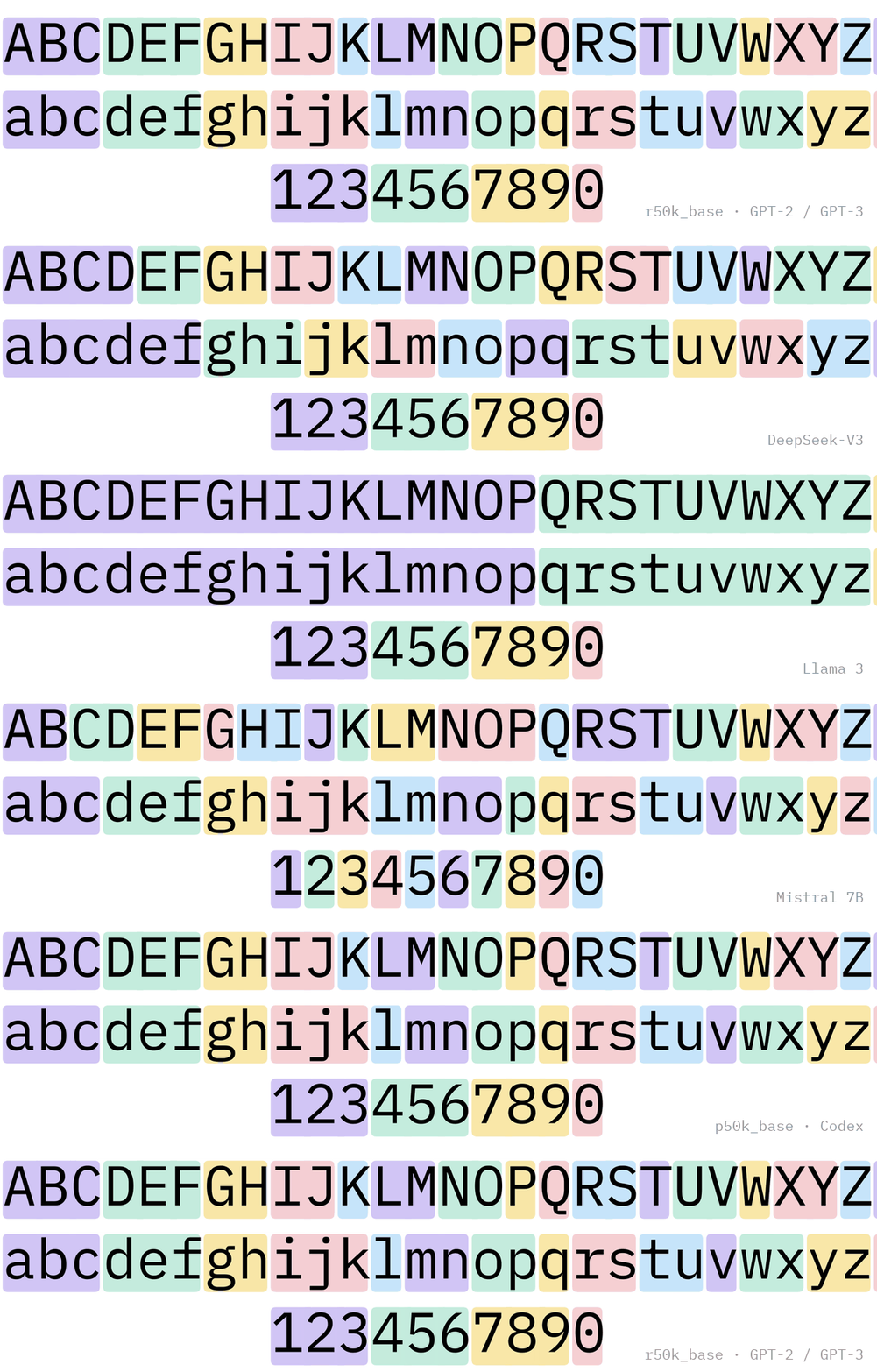
There are many tools out there that help you visualize tokens and better understand how tokenization works with large language models. OpenAI has a pretty nice one, and there are a half-dozen other ones that are also great.
They generally work by passing text through an actual tokenizer, retrieving the resulting token boundaries, and highlighting them in the browser. It's a fast, accurate and perfectly reasonable approach.
So I did the slightly unreasonable thing and made a font that uses modern font witchcraft to visualize tokens as you type them, without actually tokenizing. The code is at:
You can play with it below. Every highlight is drawn by the font. No scripting! The only JavaScript here is swapping which face is loaded.
OpenAI GPT-4, GPT-3.5, text-embedding-3; also Phi-4, OLMo 2, IBM Granite 4
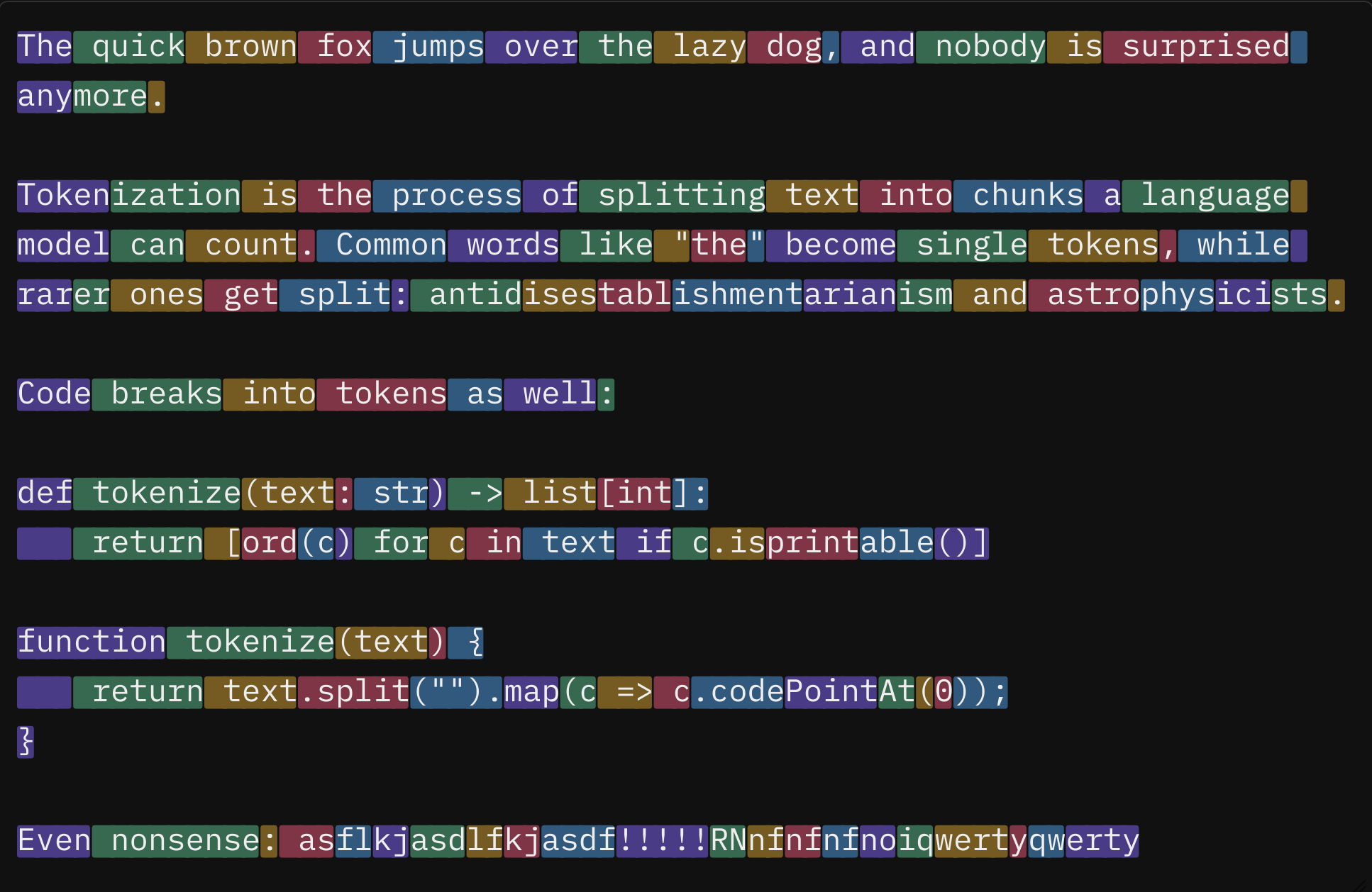
A token is the basic unit of currency for a language model. It’s what the model actually reads and produces.
A token is generally a chunk of text: a character, word, word-part, or occasionally a longer sequence. Many modern LLM tokenizers have a fixed vocabulary of these chunks, typically somewhere between 50,000 and 250,000 entries.
And that vocabulary isn’t necessarily exclusively made up of conventional words. Common combinations of characters, punctuation, whitespace, and even sequences spanning multiple words can all earn their own entries.
Where does a vocabulary come from? Nobody writes it by hand. Almost every tokenizer in this post uses some form of byte-pair encoding (BPE), which builds the vocabulary by counting. In a simplified version of BPE, start with every character (or byte, in byte-level tokenizers) as its own token. Look through a big pile of training text for the pair of adjacent tokens that appears most often, say "t" followed by "h", and merge it into a new token "th". Now look again: maybe "th" followed by "e" is the most common pair, so "the" becomes a token.
Rinse and repeat this many thousands of times over. Every merge adds one entry to the vocabulary, and the list of merges, in the order they were learned, is saved along with it. To tokenize new text, the tokenizer breaks it into characters and replays those merges in the same order, so common words collapse into a single token and rare words stay in pieces. The exact split of a word depends on which merges rank higher, which matters later.
Over a long enough timeline, does the entirety of Alice in Wonderland become a single token? Every published version of something like the Bible? Interesting thought exercise.
While they aren't incorporating entire novels or religious texts as tokens yet (and I suspect there's a better technique that enters the room well before we push things to that scale), these vocabularies have been getting bigger! GPT-2 had 50,257 tokens; GPT-4's tokenizer has 100,277; GPT-4o's has 200,019.
Part of that growth reflects increasingly ambitious multilingual support: OpenAI's GPT-4o announcement shows the same Gujarati sentence dropping from 145 tokens to 33 under the new tokenizer, while English barely moved.
Sidenote: Rest of World has a nice article on the cost of AI for non-english languages which touches on this idea of multilingual support, tokens and how this manifests visually. I think not discussing Chinese at all—which can be more token efficient than latin script languages sometimes!—was kind of a miss.
So when something like Meta’s Muse product boasts giving you 1 billion tokens for free, that’s what we’re talking about: a billion units of text processed, not a billion words (The rule of thumb seems to have settled around 0.75 words per token, so if it helps you can multiply any token count by that and read it as words.). And depending on which tokenizer is doing the counting, that same text might consume a surprisingly different number of tokens!
Writing this makes me want to start charging in tokens (i.e. words) in my day-to-day life. Hm.
Further reading on tokens: the BPE paper, Sennrich et al. 2016; SentencePiece, Google's take, used by Llama 2, Gemma and T5; and Hugging Face's tokenizers library, which reads most of the open ones.
Tokenizer Mono is a font family with different faces mapped to different tokenizers. This lets you visualize the tokens as you type without an additional computation and reassembly step.
It's one big typographic family—"Tokenizer Mono" based on IBM Plex— with a style per tokenizer model. Font Book on macOS should register them as one family with twenty-eight styles.
| Vendor | Face | Used by |
|---|---|---|
| OpenAI | cl100k | OpenAI GPT-4, GPT-3.5, text-embedding-3; also Phi-4, OLMo 2, IBM Granite 4 |
o200k | OpenAI GPT-4o, o1, o3, GPT-4.1, gpt-oss | |
p50k | OpenAI Codex, text-davinci-002/003 | |
r50k | OpenAI GPT-2, GPT-3 | |
clip | OpenAI CLIP, Stable Diffusion prompts (lowercases; no whitespace tokens) | |
| Meta | llama4 | Meta Llama 4 |
llama3 | Meta Llama 3 / 3.1 / 3.2 / 3.3; also SmolLM 3 | |
llama2 | Meta Llama 2 (SentencePiece) | |
gemma3 | Google Gemma 3 | |
gemma | Google Gemma 1 / 2 | |
t5 | Google T5 (SentencePiece Unigram, not BPE) | |
bert | Google BERT (WordPiece; ## continuations approximated) | |
| Mistral | mistral | Mistral 7B v0.3 (SentencePiece) |
tekken | Mistral Nemo, Mistral Small 3 (Tekken); also NVIDIA Nemotron-H, Swiss AI Apertus | |
| Alibaba | qwen | Alibaba Qwen 2 / 2.5 / 3 |
| DeepSeek | deepseek | DeepSeek V3 / R1 |
| Zhipu | glm | Zhipu GLM-4.5 |
| Tencent | hunyuan | Tencent Hunyuan |
| Baidu | ernie | Baidu ERNIE 4.5 (SentencePiece) |
| ByteDance | seed | ByteDance Seed-OSS |
| 01.AI | yi | 01.AI Yi (SentencePiece) |
| IBM | granite | IBM Granite 3 and Granite Code (StarCoder vocabulary); also StarCoder |
| TII | falcon3 | TII Falcon 3 |
falcon | TII Falcon | |
| EleutherAI | neox | EleutherAI GPT-NeoX, Pythia |
| BigScience | bloom | BigScience BLOOM (multilingual) |
| UW | superbpe | UW SuperBPE for OLMo 2 (tokens cross word boundaries) |
| Moonshot | kimi | Moonshot Kimi K2 (tiktoken-format vocabulary) |
Here's the same sentence visualized in all of these different tokenizers.
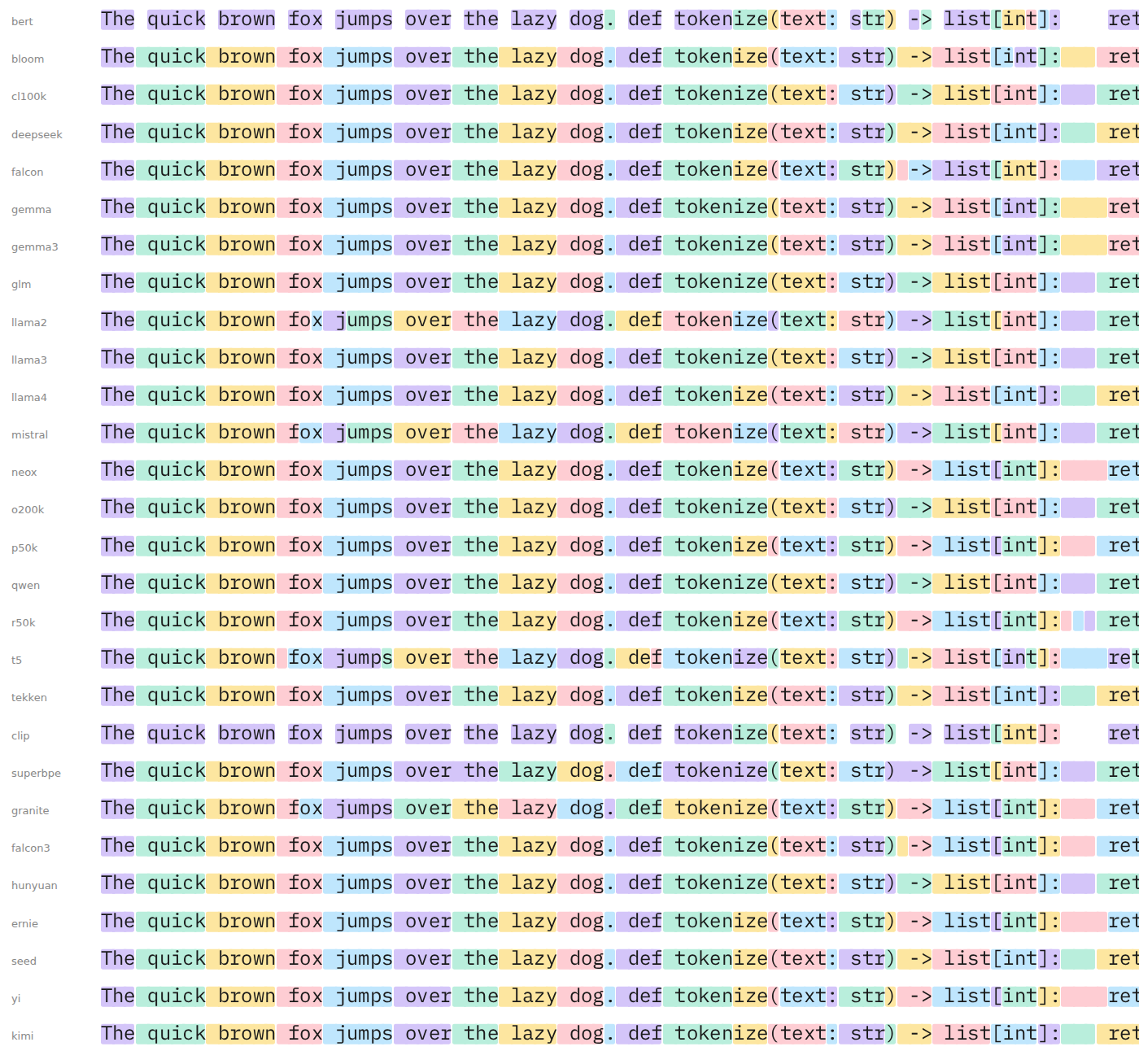
It's subtle, but you can spot some fun differences. Llama 2 splits "fox" and "tokenize" where OpenAI (among others) doesn't. BERT doesn't tokenize whitespace at all (it will never be good at Python, alas). And while we're on whitespace and Python: cl100k takes the four-space indent before return and makes one token of the first three spaces, then folds the fourth into " return", while Gemma keeps all four spaces as a single token.
Note on vendors and models: Anthropic's tokenizer isn't public, as far as I can tell, so there's no Claude face. Neither is Gemini's, though I wouldn't be shocked if it's some evolution of Gemma? OpenAI publishes its encodings through tiktoken, and its model table maps everything up to GPT-5 onto o200k_base, so the o200k face covers those. I'm not sure about the newest models like Astra (GPT-6).
This entire project was an exercise in seeing how far I could push OpenType glyph substitutions—something I knew existed and understood conceptually, but had never played with.
Microsoft's OpenType spec pages explain this elegantly, in my opinion.
In a nutshell, the Glyph Substitution table (GSUB) is the part of an OpenType font that holds rules for replacing one or more glyphs (the drawn shapes, as opposed to the characters underneath them) with other glyphs. The spec numbers eight lookup types; seven of them substitute something, and the eighth is a wrapper you'll meet in the list. The examples below are in Adobe's .fea syntax, which is how most type designers write them.
sub zero by zero.slash;. Small caps are the same trick, just 26 times over.sub f_i by f i;.sub ampersand from [ampersand.1 ampersand.2 ampersand.3];.sub f i by f_i;. Fira Code's !== arrows are this. This is the thing I half-remembered about fonts and went to look up before any of this started, i.e. "how do ligatures actually work?", and here we are, one weird font and a blog post later.sub [a e o]' r' lookup connect;. Every glyph in the match is fair game, but there's nothing to look at outside the match.sub @letter f' i' r' e' lookup toRed; only fires when a letter precedes "fire". That's how the font tells " hello" from " hellos".rsub e' space by e.final;.Rules are written in Adobe's feature-file language, .fea. The warm-up font in the repo turns the word "fire" red, and only the whole word, in eight lines:
@letter = [a-z A-Z];

lookup toRed {
  sub f by f.red;  sub i by i.red;  sub r by r.red;  sub e by e.red;
} toRed;

feature calt {
  ignore sub @letter f' i' r' e';        # not "misfire"
  ignore sub f' i' r' e' @letter;        # not "fired"
  sub f' lookup toRed  i' lookup toRed  r' lookup toRed  e' lookup toRed;
} calt;
The tokenizer font is that idea pushed to a silly extreme. One rule per vocabulary token, longest first, keyed on the first glyph. When the shaper matches one it rewrites the letters to start / middle / end variants and skips past the match. That skip is what makes it greedy longest-match. In .fea terms, the rule for " hello" would be:
sub space' lookup toStart h' lookup toMid e' lookup toMid l' lookup toMid l' lookup toMid o' lookup toEnd;
(At this scale the .fea compiler can't cope, so the rules are built directly as table data with fontTools. Same thing, no text form.)
A 22-rule state machine then paints the colors (yes, fonts can have colors; that's the next section!), looking one glyph to the left:
# continuation inherits its neighbor's color (k = 0..4)
sub [@S0 @M0] @M' lookup toM0;
sub [@S0 @M0] @E' lookup toE0;
# a new token takes the next color after a token end
sub [@E0 @X0] @S' lookup toS1;
sub [@E0 @X0] @X' lookup toX1;
# ...same four lines for colors 1 to 4, wrapping 4 -> 0...
# first token in the run
sub @S' lookup toS0;
sub @X' lookup toX0;
A few years ago I discovered Google's Noto Color Emoji font and learned you can put colors in fonts. What a neat trick! For this endeavor, while I figured substitution rules might be able to mark where the tokens start and stop, color would make it even snazzier and start to look and feel like the tools I shared toward the top.
Color in OpenType involves two tables working together. COLR says "this glyph is these layers, drawn in this order," and CPAL holds the palettes those layers pick their colors from.
COLR comes in two versions. Version 0 is flat fills, one palette color per layer, and is all I needed for Tokenizer Mono. Version 1 adds gradients, transforms and compositing, which is what Noto Color Emoji's web build uses. Chrome's COLRv1 announcement is a good explainer if you want to go further. Twemoji and Microsoft's Segoe UI Emoji ship COLR builds too.
In Tokenizer Mono every colored letter is two layers: a rounded box filled from palette slot k, and then the original letter on top in "whatever the text color is" (palette index 0xFFFF, a special value meaning "use the current foreground"). With fontTools the whole thing looks like this:
from fontTools.colorLib.builder import buildCOLR, buildCPAL font["CPAL"] = buildCPAL([ [(0.83, 0.77, 0.98, 1), (0.73, 0.93, 0.86, 1), ...], # palette 0, light backgrounds [(0.30, 0.23, 0.54, 1), (0.12, 0.42, 0.31, 1), ...], # palette 1, dark backgrounds ]) font["COLR"] = buildCOLR({ "a.s0": [("box.start", 0), ("a", 0xFFFF)], # box in color 0, then the letter "a.m0": [("box.mid", 0), ("a", 0xFFFF)], # ... 1,001 characters x 4 shapes x 5 colors })
A CPAL table can hold more than one palette. Each index in the list in the example above maps to a layer you can refer to by slot number (i.e. index). So the same box glyph that fills from slot 0 can be pale lavender in one palette and deep purple in another, with nothing else in the font changing. Tokenizer Mono ships two: pastels for light backgrounds and darker, more saturated versions for dark backgrounds. The page on this demo picks between them with the CSS font-palette property depending on if you have dark mode enabled:
@font-palette-values --tok-dark { font-family: "Tokenizer Mono cl100k"; base-palette: 1; } @media (prefers-color-scheme: dark) { textarea { font-palette: --tok-dark; } }
It fails pretty elegantly too. Anywhere COLR isn't supported (which isn't that many places these days; it's widely supported), like most terminals and a lot of native text fields, the boxes simply don't draw and you're left with plain, colorless IBM Plex Mono.
Greedy longest-match is not BPE. Remember that a BPE tokenizer splits text by replaying its merges in the order they were learned. The font can't do that. A substitution rule matches a fixed run of glyphs, so the best it can do is take the longest token that fits and move on. Usually that lands in the same place, which is why this font felt fun-enough to share. Sometimes it doesn't.
Take "antidisestablishmentarianism" in cl100k. In the middle of a sentence the word arrives with a leading space, and the font grabs " antid" because it's the longest token that fits there. BPE's merges for " ant" and "idis" rank higher, so the real split is ant|idis|establish|ment|arian|ism and the font's is antid|ises|tabl|ishment|arian|ism. At the start of a line there's no leading space, " antid" can't match, and the font gives a third answer: anti|dis|establish|ment|arian|ism, which looks the most sensible of the lot. (You'll see that one in the demo whenever the word is long enough to wrap onto its own line; see Known gaps.) BPE isn't trying to match how a person would break the word. It only reflects which character pairs were common in its training data, and "ant" was more common than "anti".
The fix was to hard-code answers. The build script uses the 60,000 most common English words from wordfreq and runs them through the real tokenizer and adds a whole-word rule wherever greedy would have gotten it wrong. It's goofy, but a whole-word rule is longer than any token inside it, so it works. Nothing is emitted where greedy was already right, so common words cost nothing. A second pass adds rules for any longer word a shorter rule would otherwise shadow, so " byte" can't fire inside " bytes". In other words, the word rules are a hard-coded answer key
Couldn't you keep going and add every word the greedy matcher gets wrong until it's perfect? In theory, yes! A big enough list would make the font exact on every word in it and it would work.
A few things make this impractical:
The first is cost. The cl100k face went from 4.4 MB to 10.9 MB as a TTF when the 60,000-word list added about 92,000 rules (I started with 10,000 words), so roughly 70 bytes per rule, or about 7 bytes in WOFF2. Each word gets up to four forms (leading space, capitalized, line-initial, all caps), and about half of those turn into rules. A million-word list would mean something like a million and a half rules, so on the order of 100 MB as TTF and 10 MB as WOFF2 per face. I am slightly tempted, and I won't rule out turning this into a 100 MB+ font someday, but a demo is better for now.
A more interesting challenge is performance. I bet nobody thinks about performance variance between fonts! Rules are grouped by their first glyph and tried longest-first, so the work the shaper does at each character grows with the number of rules that start with that letter. Today that's about 50 microseconds per character. Fifteen times the rules wouldn't be 15x times slower, since HarfBuzz indexes the rules rather than scanning them, but typing would start to feel it.
The third is that the words run out before the misses do. wordfreq's English list goes a few hundred thousand entries deep before it turns into noise, and the long tail is names, misspellings and concatenations, which the tokenizer treats like code anyway. Past a certain point you're spending megabytes on rules that fire almost never, and the remainder, identifiers, URLs and other languages, is the same size no matter how long the list is. Greedy plus a frequency-ranked cheat-sheet gets you to 98% coverage on this 60,000-word list, the last 2% is rare words (antidisestablishmentarianism didn't even make the list) and code, and no amount of hard-coding reaches 100% because the input isn't a closed set.
The real fix would be a font that replays merges instead of matching longest-first, which is what the SuperBPE pass does in miniature. A full replay needs one lookup per merge rank, applied in order, and OpenType caps a font at 65,535 lookups. cl100k has about 100,000 merges.
Every tokenizer treats a run of spaces differently. tiktoken keeps the last space for the next word. Gemma keeps the whole run and gives the next word no space. T5 collapses the run to one token. BERT doesn't tokenize whitespace at all! Rather than hard-code this, the build script probes each tokenizer with a real sample and picks the rule shape from the answer.
The vocabulary files lie a little. Gemma stores its whitespace tokens as "added tokens" in a separate list from the main vocabulary. Byte-level tokenizers report empty offsets for whitespace-only tokens. Both bit me, and both showed up the same way: a face scoring 40% or 70% for no visible reason.
SuperBPE broke greedy matching outright. Its tokens cross word boundaries, so the vocabulary has entries like ", h", and "one, half" became ", h" + "alf". " fan of" won over " of the" where real BPE does the opposite. The fix was to do what BPE does: shape the single words first, then re-shape the superwords in rank order as merges of tokens that already exist, matching the exact shape pattern of their parts. One rule per way of building a superword from smaller ones, so "By the way" can form on top of " the way". That took it from 86% to 93% boundary agreement, and the hand-picked sentences from the SuperBPE playground in my testing now match.
Testing by eye against a playground is slow. tools/compare.py superbpe "any sentence" prints both splits side by side, and the corpus check lists the font tokens that most often disagree with the real tokenizer.
When I claim "98% accuracy" for some of these, what does that even mean?
The corpus is about 200 lines of mixed text that live in the repo as fonts/tokenizer/corpus-large.txt: a few paragraphs of prose, the text of the SIL Open Font License, 120 lines of Python from the standard library, some JavaScript and SQL, and a few lines with curly quotes, accented words and currency symbols. Nothing in it was used to build the font. Our word rules come from a frequency list, not from this corpus.
The method is to shape each line with HarfBuzz, the same engine Chrome and Firefox use, and read back which glyphs came out as "start of token" variants. That gives the font's set of token boundaries as character positions. Then run the real tokenizer (tiktoken or the Hugging Face tokenizers library) on the same line and take its boundaries and compare the two sets.
Precision is the share of boundaries the font drew that the real tokenizer agrees with; a face that over-splits has low precision. Recall is the share of the real boundaries the font drew; a face that under-splits has low recall. Most faces are within a point of each other on the two, which means the errors are "different split" rather than "too many" or "too few".
Why boundaries and not token IDs? The font doesn't know IDs. It only draws where tokens start and stop, so that's the only thing it can be right or wrong about. I'm also completely new to all of this and am curious if there are other/better techniques with OpenType for this weird problem I've created (though I kind of like what a brute-force solution this ended up being).
A few caveats: Line breaks are hard boundaries for both sides, since each line is tokenized alone. The corpus is English and code, so a multilingual tokenizer like BLOOM is being judged on the part of its vocabulary it uses least. A different corpus would move the numbers by a point or two. The measurement script is tools/tokcheck.py, and CI prints the table for every face on every push.
So the reader can see what the missing 2% looks like, here are two misses. cl100k splits " antidisestablishmentarianism" as ant|idis|establish|ment|arian|ism; the font draws antid|ises|tabl|ishment|arian|ism. Same word, same letters, different seams. In code it's identifiers: xMinYMax is x|Min|Y|Max to cl100k and x|Min|YM|ax to the font.
A few things the font can't do, and one thing browsers do to it.
white-space: nowrap and scroll sideways, or insert hard line breaks where you want them.Boundary agreement with the real tokenizer on the corpus above, from the CI run that built the fonts in the demo (November 3, 2026), sorted by precision.
| face | precision | recall | tokens font / real | shaping | TTF |
|---|---|---|---|---|---|
| bert | 99.5% | 99.3% | 3341 / 3348 | 4 µs/char | 5.0 MB |
| r50k | 98.9% | 98.9% | 3758 / 3755 | 60 µs/char | 8.6 MB |
| gemma | 98.7% | 98.6% | 2963 / 2965 | 46 µs/char | 14.5 MB |
| yi | 98.6% | 98.7% | 3209 / 3208 | 44 µs/char | 8.6 MB |
| p50k | 98.5% | 98.6% | 3073 / 3070 | 42 µs/char | 8.6 MB |
| gemma3 | 98.5% | 98.5% | 2975 / 2976 | 45 µs/char | 13.8 MB |
| neox | 98.4% | 98.2% | 3004 / 3011 | 43 µs/char | 8.8 MB |
| granite | 98.3% | 98.2% | 3108 / 3109 | 54 µs/char | 9.7 MB |
| ernie | 98.0% | 98.1% | 3050 / 3047 | 48 µs/char | 9.8 MB |
| qwen | 98.0% | 97.9% | 2861 / 2864 | 46 µs/char | 11.1 MB |
| cl100k | 98.0% | 97.9% | 2823 / 2826 | 45 µs/char | 10.9 MB |
| hunyuan | 98.0% | 96.6% | 2824 / 2865 | 45 µs/char | 10.8 MB |
| llama3 | 97.9% | 97.8% | 2825 / 2826 | 48 µs/char | 11.3 MB |
| mistral | 97.8% | 98.4% | 3218 / 3199 | 50 µs/char | 8.6 MB |
| o200k | 97.8% | 97.9% | 2802 / 2800 | 52 µs/char | 13.1 MB |
| glm | 97.8% | 96.9% | 2802 / 2829 | 48 µs/char | 11.7 MB |
| llama2 | 97.7% | 97.8% | 3266 / 3265 | 51 µs/char | 8.8 MB |
| kimi | 97.7% | 97.6% | 2810 / 2811 | 45 µs/char | 10.3 MB |
| falcon3 | 97.5% | 98.6% | 3112 / 3075 | 41 µs/char | 11.4 MB |
| deepseek | 97.5% | 97.6% | 2924 / 2921 | 46 µs/char | 9.9 MB |
| falcon | 97.3% | 98.3% | 3225 / 3192 | 43 µs/char | 9.1 MB |
| llama4 | 97.3% | 97.4% | 2815 / 2813 | 55 µs/char | 13.6 MB |
| seed | 97.2% | 97.5% | 2925 / 2916 | 47 µs/char | 10.5 MB |
| tekken | 97.1% | 97.2% | 2977 / 2975 | 51 µs/char | 11.2 MB |
| clip | 96.7% | 96.9% | 2984 / 2978 | 5 µs/char | 9.0 MB |
| bloom | 94.5% | 95.0% | 2893 / 2877 | 58 µs/char | 12.9 MB |
| superbpe | 93.0% | 94.5% | 2384 / 2346 | 53 µs/char | 15.4 MB |
| t5 | 85.7% | 94.1% | 3605 / 3280 | 35 µs/char | 7.1 MB |
Most faces land between 97% and 99%. BERT tops the table because WordPiece really is greedy longest-match under the hood, so it needs no word rules at all! r50k (GPT-2) is next; its small vocabulary leaves fewer ways to be wrong. The three at the bottom are explained by their algorithms: BLOOM is multilingual and its English vocabulary collides with tokens from other languages, SuperBPE's tokens cross word boundaries, and T5 is Unigram.
The fonts run from 5 to 15 MB as TTF and roughly a tenth of that as WOFF2. SuperBPE is the biggest at 15.4 MB, with its superword rules stacked on a 200k vocabulary, then Gemma 2 at 14.5 MB. BERT is the smallest at 5.0 MB; its 29k-token vocabulary is a fraction of the others.
Shaping costs 40 to 60 microseconds per character for the BPE faces on the CI runner, and a few microseconds for BERT and CLIP, which have far fewer rules. A 10,000-character document re-shapes in well under a second, and browsers only re-shape the paragraph being edited.
Hilariously, at 40 to 60 microseconds per character, I started wondering whether this is actually any faster than sending the text to a service that tokenizes it, returns the pieces, and having the client reassemble and highlight them. All that work only to arrive at something that might be less accurate and slower.
As that thought landed I ran a quick check, on my laptop, same 12,265-character corpus for both, line by line:
| per character | 500-char paragraph | 10,000-char document | |
|---|---|---|---|
| the font, shaped by HarfBuzz | 34 µs | 17 ms | 343 ms |
| tiktoken, running locally | 0.11 µs | 0.06 ms | 1.1 ms |
So: about 300 times slower than doing it properly. I'm so proud.
Painting a span per token on the client adds a few milliseconds to the tokenizer's side, which still leaves the font two orders of magnitude behind. Against a network round trip of 30 to 100 ms it's closer to a tie: the font wins for a paragraph and loses for a document.
The one thing in the font's favor is that browsers only re-shape the paragraph you're typing in, so what you actually pay per keystroke is the 17 ms row, and nobody can probably feel that.
No regrets.
Everything in Tokenizer Mono swaps glyphs for other glyphs of the same text. But a substitution rule doesn't have to. We can match a whole phrase, collapse it into one glyph, and expand that glyph into something else entirely. Good becomes evil. Up becomes down. Yes is no.
My half-baked idea after landing this was "To what degree could we be replacing glyphs with the would-be response tokens to these tokens from an LLM?" A model in a font (kinda).
So, in principle: a font where typing "What is the capital of Oregon?" could render as "Salem is the capital of Oregon." It would be deterministic, but the rule fires when the question mark lands, the answer appears in place of the question, and the document underneath still says what you typed. Select it, copy/paste it and you get the question back.
It would basically be a lookup table though, not a model. The font could only answer questions someone enumerated at build time, exactly as spelled. ELIZA packed into a font maybe. I'm putting a pin in it as the next silly font project.
If you want the real thing though, it exists! And it's wonderful. Pure OpenType substitution is a finite-state machine, which is enough for Fontemon (a playable Pokémon-style game that lives entirely inside a font). For an actual language model you need more than a state machine, and HarfBuzz has a Wasm shaper that lets a font carry arbitrary code (which is kind of insane to me): llama.ttf uses it to bundle a small Llama model and its inference engine inside a font file, so typing a prompt generates text. No browser enables that Wasm shaper, thank goodness, but the ceiling for "a font that does things" is a lot higher than you'd think.
Credits: IBM Plex (OFL), fontTools, HarfBuzz, tiktoken, Hugging Face tokenizers, wordfreq.
Every "used by" claim in the table above was checked against the vendors' own tokenizer files, not model cards or press. For public repos the tokenizer.json vocabulary and merge list were downloaded and compared directly. For gated repos (Meta, Google, Mistral, BigCode) the comparison uses the file hashes Hugging Face publishes in the repo metadata, or a public repo that ships the byte-identical file.
If you enjoyed reading this consider sponsoring my work on GitHub or subscribing to my newsletter.
Share this post: Hacker News • Reddit • LinkedIn • Mastodon.
Published on Wednesday, November 4th 2026. Read this post as plain-text.
Working Notes: a commonplace notebook for recording & exploring ideas.
Home. Site Map. Subscribe. More at expLog.
— Kunal
This particular note is around exploring cognitive surrender: uncritically accepting whatever agents output without actually thinking, exploring or considering alternatives. Working this way is extremely fast, not particularly taxing, and unsurprisingly seductive.
And yet I find myself repeatedly questioning if this is actually a good way to apply agents: often enough I find myself making suboptimal decisions, accruing technical debt and reducing my familiarity with the system I’m working on instead of improving it.
As we collectively rethink how we work I’ve been finding it useful to read and share other people’s workflows, and consciously write about and examine my own. This particular post focuses on finding the right balance of trust while working with agents.

One of the virtues of being a great programmer is to be lazy. After more than a decade of training myself to look for the shortest and simplest path it’s rather attractive to be able to simply hand over the problem. If I can spin up a software factory, why wouldn’t I?
There’s also a lot of peer pressure (or game theory) at work: if any of my colleagues have seemingly surrendered, then I’m only going to look worse if I spend too much time trying to do silly things like understanding what I’m working on. And, of course, while everyone else is a slop-cannon generating code faster than they can read it I can build a meticulously designed software factory manufacturing perfect designs. The sheer volume of work also appears remarkably productive – we’ve all talked about just how many more PRs we ship every day.
This tends to get compounded by the agents’ expressed confidence & conviction. Perhaps an inadvertent consequence of RLHF, but models tend to be astonishingly confident in what they recommend (and perhaps even more blasé while admitting they made a mistake). This makes it too easy to take their answers at face value, with whatever social programming I seem to have evolved with.
OSS projects – particularly those facing time pressure – seem to accrue tremendous complexity quickly, to the point that it feels like the only way to interact with a project in any sane time frame is by heavily relying on agents to navigate and modify and test the code. This is also a self-reinforcing feedback loop: broken windows multiply rapidly with agents on the loose. [1]
Technical debt and incidental complexity have a fairly attenuated feedback loop: complexity introduced by slop doesn’t bite immediately; it’s far more subtle and compounds over time when I’m not paying attention.
Beyond all of that, I have to mention the hype cycle. We all should be skipping Netflix to watch talks by Anthropic engineers on making loops (or the agentic workflow du jour). [2]
It’s not entirely obvious that it’s a bad idea to surrender: if it’s easier and better, then why not take that path? So far, my personal answer is that I need to take the easier path consciously and intentionally, with enough effort to mitigate downsides.
Part of what makes me deeply uncomfortable is suffering from a form of Gell-Mann amnesia while working with agents. When I have expertise and the overall design direction I can generally simplify the output significantly, controlling for complexity. When I don’t they seem to be the smartest engineers in existence – far beyond the more squishy, organic variety – and all I can do is follow in awe. And then the agent gets stuck creating a directory and I have to reset all my assumptions.
For the current state of the art (October 2026) I generally find maximal use of agents leads to a significant explosion in complexity: something that mostly works, with extremely surprising edge cases and bugs. These are generally the projects with hundreds of thousands of lines of code shipped rapidly, breaking the scale supported by most software development tools, so you also need to revisit those – and this compounds rapidly.
I have a strong aversion to incidental complexity, and generally refuse to build, maintain or extend it: it’s fine for a proof-of-concept, but it must end there. For systems that need to keep working, steering the design aggressively towards simplicity and modularity is what lets me build something I can actually operate (with and without agents).
As models continue to improve rapidly, I expect the previous argument to go away as the models learn and can express a broader sense of engineering taste, good design and quality. The other reason – which I unfortunately expect to persist – is that my personal understanding and mechanical sympathy for systems I maintain erode extremely rapidly, or never get a chance to develop.
In the early days when I would build things by hand I’d be able to quickly diagnose any bug or misbehavior based on my familiarity with building and maintaining the code: the more I rely on agents, the more my only option is to spin up one more session and hope; and the automated fix then further reduces my understanding in a self-reinforcing loop. Without context, I no longer have much meaningful judgement and can’t engage – or handle it in context.
The Ironies of Automation (1983) is referred to often in articles similar to this one. I’d recommend directly reading the paper if you haven’t: it’s fully relevant to the decisions we have to make today. The paper warns that it becomes even harder to deal with tasks an agent fails at because we never manage to get any practice with the easier tasks; nor do we get a chance to internalize what a system feels like under standard operating circumstances.

At the end of the day, I’m responsible and accountable for what I build, not the agents. Surrendering agency and not thinking basically makes me accountable without any meaningful ownership. There’s also the small matter of pride in the quality of my work.[3]
The sombre opening shouldn’t lead you to believe that I’m not excited about the sheer potential unlocked by AI, and the opportunities to build things that I would never have been able to without it. It’s more about resetting expectations, explicitly working through the tradeoffs involved and choosing which ones are acceptable. And finding ways to maintain the quality and craftsmanship I care about.
The first step for me has been to internalize that I can’t truly have my cake and eat it: I can go terribly, inhumanly fast at building things but I need to accept that there’s no way to retain the mechanical sympathy, depth and confidence I used to have without putting in the effort. Time that used to be only counted as building a system also involved comprehension; agents can drive the time to build to zero but the next bottleneck – comprehension – hasn’t moved much so far.
The hype cycle occasionally can make it hard to communicate this explicitly: a lot of the communication around agentic loops tends to assume that there are no downsides whatsoever.
Several months ago I defined my vibe limit as the complexity of the change I can make with sufficient confidence using agents. I like the risk/complexity curve enough to post it again:

The next step is figuring out where I land: there are several projects where good enough is fine, or the problem is sufficiently sandboxed that I’m happy to live with whatever the agents generated. On the other hand, if the system is important, fragile, can’t be sanity checked easily or isn’t particularly well isolated I need to directly spend my time.
Aggressive prioritization, triage, and constantly recalibrating myself become really important in this ecosystem: I should explicitly choose where to surrender agency and where to spend my time (not unlike leading a team, except the pace is much faster). Constantly reviewing my predictions and the outcomes helps a lot in recalibrating, particularly with new model drops.
I also find myself needing to be much more mindful while working. A warning sign I watch out for these days is if I find myself repeatedly tapping “yes, continue” in a session. At that point either I should figure out what it would take to completely delegate the problem to Claude instead of trying to micro-manage the agent – or realize that I stopped thinking and I need to check the decisions being made.
Completely delegating the problem generally means building a better sandbox or feedback loop, or figuring out ways to be able to sanity check much more easily before shipping to production. Alternatively, if I need to engage much more deeply I’ll use some of the other tactics described below.
The premise of augmenting myself by working in the loop with powerful thinking machines was a large part of my decision to join my current company. This generally comes down to directions you can give the model to reduce the size of the steps it takes, or explicitly choosing to drive instead of passively observing.
For projects I deeply care about, choosing to drive instead of letting the model drive is one way to intervene in every single decision. It’s much slower to type things out, but it does force me to engage with every decision and gives me an opportunity to override it. In fact, for this post I’m using a Codex session to edit: help me tighten the post, point out the small typos, punctuation errors, or half-finished sentences that tend to embarrass me after I explicitly share a post publicly – but I make all changes by hand.
In the AGENTS.md for the notebook:
Never edit files directly, always wait for the author to request or confirm changes, or let him make the edits directly.
This is reminiscent of how I used to work with Stack Overflow: never copy-paste code; instead write it out explicitly while cross-checking with documentation. Either I’d learn and internalize something new or I’d realize the Stack Overflow answer was suboptimal or outdated.
We don’t need to limit ourselves to existing interfaces anymore: with agents it’s also possible to have them build a tremendous amount of scaffolding to support comprehension and make changes in ways that are digestible.
Often enough for larger, complex stacks I have the agents build me a custom view for the Pull Request with 4 columns: the standard 2 for the diff, a 3rd column with running commentary from the agent on why it made a particular change and finally the 4th column as a place for me to add comments and directions.
Getting the agents to make stacks of changes with the explicit direction to “Make the change easy, then make the easy change” works really well. I used to spend a lot of time trying to make my diffs easily reviewable to respect the reviewers’ time – now I can ask the agents to do the same for me.
It’s also very valuable to dive into actual execution with a debugger (or have an agent manipulate the debugger on your behalf) till you get a deep sense of how things are flowing through the program, with the confidence that this is the real execution path.
Another example is to make harnesses explain what they’re doing: I’ve built several variations of command-line helpers that transparently fit into my shell sessions (x being the last public version). In my most recent iteration, I explicitly ask the model to explain any obscure flags and commands used so that I can learn as I go.
Sometimes, it does make sense to hand over the problem to an agent: it could be too big, not valuable enough, time could be too short, or you just want to get a first prototype out to explore a problem end-to-end.
This one is probably an essay by itself: adapting old-school best practices when you have infinitely fast stochastic intelligence on top. The idea here is to reduce the risk in making changes, flattening the vibe-limit curve and making it possible to make bigger changes safely.
Beyond giving the agent some means to verify itself against the goal you’re aiming for, I find it very useful to:
In Notes on the Synthesis of Form Christopher Alexander has a wonderful example demonstrating the value of decomposition – or building a lightly coupled, cohesive system to be able to succeed quickly.
No complex adaptive system will succeed in adapting in a reasonable amount of time unless the adaptation can proceed subsystem by subsystem, each subsystem relatively independent of the others.

Whether agents or humans are doing the work, a good design makes the system much easier to understand, iterate on, validate and extend. As you learn the limitations of the design, you also now have the ability to redo it much more rapidly than ever before. Regardless of how much depth you decide to maintain in your projects, I’d make sure the broader structure continues to make sense.
There are several interesting articles, talks and books that are relevant:
I’m curious if you have any other recommendations around effectively leveraging agents without losing context – I’d love to hear about additional experiments to try or workflows to adopt! Particularly if you’ve successfully recovered projects that collapsed into slop. Discuss on Hacker News.
I have constantly been expecting more software to fail under the weight of its own complexity. One of my hot takes is that this hasn’t happened at the scale and magnitude I expect yet because agents became smarter fast enough to keep up with the debt introduced by the previous generation. ↩︎
You’ll pry my weekly indulgence in The Great British Baking Show from my cold, dead hands. ↩︎
You could argue that this is a very “Individual Contributor” approach to building things, and that managers deal with this all the time. I’ll quote Andrew Grove on management: “delegation without follow-through is abdication” – you still need to engage to get the outcome you need. ↩︎
This blog post is about touch screen Macs, but I’ll start by talking about touch screen cars. Vehicle manufacturers have increasingly replaced physical controls in cars with touch screens, and it hasn’t gone well, because the touch screens frustrate drivers. As a resident of the Upper Midwest who drives wearing gloves in the winter, I suspect that the idea for touch screens came from somewhere warmer than the traditional home of the automotive industry, Detroit. For further reading on the serious, indeed dangerous problems with touch screens in cars, I found a couple of recent articles from Popular Mechanics and The Conversation.
Smartphones have become ubiquitous, bringing ubiquitous familiarity with touch screen interfaces. Nonetheless, a touch screen is not the best interface for all purposes. In the case of cars, familiarity breeds contempt! The introduction of touch screens to smartphones was inspired by the physical limitations of the devices. The largest iPhone ever made, the new iPhone Duo, is still significantly smaller when unfolded than the smallest MacBook. Needless to say, the original 2007 iPhone was tiny compared to a MacBook. Mobile phones with a physical keyboard must have a correspondingly smaller screen, so manufacturers eliminated the physical keyboard to maximize screen size, relying entirely on a touch screen interface, including a software keyboard. In this case, touch screens were well motivated.
Over the years I’ve owned many different computing devices of various sizes; from Apple: iMac, Mac Pro, Mac mini, MacBook Pro, iPhone, iPad. I’ve never once tried to control a Mac by touching its screen, not even absentmindedly. I simply never developed that habit. Many other people, however, when first introduced to a Mac, having only used touch screen computers such as smartphones and tablets, habitually attempt to control the Mac by touching its screen. This habit or expectation is cited as justification by defenders of touch screen Macs. In a Wired interview yesterday, Apple Senior Vice President of Worldwide Marketing Greg Joswiak said, “There’s a generation of young creators and young people using our MacBook Pros that expect to touch.” In my opinion, such an expectation is a terrible reason to introduce touch screen Macs. The habit of touching Mac screens can be broken and is worth breaking, because for most purposes the traditional Mac interface of a keyboard and indirect pointing device (mouse or trackpad) is so much more powerful and productive than the touch screen of an iPhone or iPad.
Before you cite the ungodly AAPL market capitalization as proof that Joz’s opinion trumps mine, consider how Apple is the same company that gave us howlers such as the trash can Mac Pro, Touch Bar, butterfly keyboard, Liquid Glass, and gave a gold statue to Trump. I’m not even making any claims about the future profitability of touch screen Macs. I just think it’s a poor design.
Ironically, people like me who were introduced to computers before the smartphone era are ridiculed as “resistant to change,” yet I’ve managed to learn how to use iPhones and iPads (the latter without a keyboard), so why can’t people who were introduced to computers during the smartphone era learn how to use Macs? Let me quote from a blog post I wrote earlier this year, If computers are the future, why are computer users expected to be permanently illiterate?
The iPhone seems to have engendered a culture of anti-intellectualism and learned helplessness so pervasive that users have become evangelists for their own disempowerment. They demand that all software be “intuitive,” by which they mean idiot-proof, so simple that a n00b can use the software effortlessly and effectively. A suggestion to read the fine manual is greeted with charges of user hostility. Those who habitually, endlessly scroll YouTube or social media would balk at investing a little time to master the computing tools they use daily. Perhaps they would be surprised to learn that the supposedly intuitive 1984 Macintosh came with 170 page manual. A common conceit is that the Mac was easier to use than other computers out of the box; the reality is that the Mac was easier to use after the initial learning curve. The system went out of its way to establish internal consistency and interoperability, but the user first had to make sense of the system and its principles.
A MacBook Pro is bulkier than an iPhone, can’t fit in your hand or your pocket. That’s a disadvantage. Thankfully, a MacBook Pro has many advantages that outweigh the disadvantages. The larger screen size, the physical keyboard, and the less restrictive operating system allow Mac users to perform the same tasks with vastly greater ease than on iPhone or iPad and, moreover, to perform tasks not even possible on iPhone or iPad. It’s a shame to introduce new users to Mac by telling them to use it in the same way they used their old familiar devices, which are strictly limited by both hardware and software. A Mac is a terrible thing to waste! Not only functionally but also financially, since Macs on average have higher prices and longer effective lifespans than iOS devices. Steve Jobs (long before iPhone) called computers “bicycles for our mind.” I feel that adding touch screens to Macs is like adding training wheels to our bicycles. Some kids are given training wheels temporarily, but the ultimate goal is to outgrow training wheels, not to grow into them. The difficulty of learning to ride a bike without training wheels pays off in short order, giving the rider greater speed and maneuverability. In what dystopia would we consider training wheels the future of biking? (I suppose the same dystopia that would remove the steering wheel from our cars.)
In general, Hacker News comments tend to be appalling. Occasionally, though, there’s a diamond in the rough. I’d like to end by quoting one of those. Admittedly, I haven’t independently verified the veracity of the comment, but it seems truthy enough to cite, at least as fodder for debate:
Jeff Johnson (My apps, PayPal.Me, Mastodon) Articles indexI bought a laptop for a relative and didn't realise it doesn't have touchscreen. They complained for a day and I often saw them try to touch the screen and then being disappointed it doesn't work. Week later they never mentioned it again and use the laptop just fine.
When I was buying them a second one and asked about touchscreen, they said they don't care anymore for it, so second laptop also was without touchscreen.
By Roberto Perez Alcolea, Java Platform Team

At Netflix, shared Java libraries support applications developed across a large, independently evolving repository ecosystem. A library change begins in one repository, but its impact can reach many others. Producers can see the API diff in front of them. What they often cannot see is who still depends on the symbols that changed.
The need for that visibility grows as coding agents take on more of the software development lifecycle. An agent can accelerate a local edit, but without cross-repository context it cannot judge downstream risk or help plan consumer migrations. The evidence a producer uses to assess a change can also guide the agent working on it.
Consider a common case: removing a deprecated API. Deprecated entry points expand the surface producers must test, document, and support, and they can constrain how a library evolves.
Suppose a replacement has been available for several releases and the old method cannot express options required by new behavior. The library’s tests pass, and a compatibility checker flags the removal. The producer still cannot answer the questions that determine what to do next:
At small scale, producers can ask nearby teams or search a handful of repositories. Across many repositories, it is harder to find every caller of a method and the library version each one uses. Those answers are scattered across consumer codebases and builds.
Without that evidence, a producer may release a breaking change and discover the impact through consumer failures, or preserve an old API indefinitely because the risk is unknown. Libraries need to evolve, and their producers need evidence that helps them do so intentionally.
We built Quasar to index symbol definitions and references across Netflix repositories. For library producers, that shared index helps answer two questions:
The first identifies a potentially incompatible change. The second estimates its observed blast radius. Together, they turn a generic compatibility warning into evidence a producer can act on before merging or releasing.
Existing techniques each see a different part of the problem. Binary and source compatibility tools identify contract changes, but cannot tell who uses the changed API. Dependency graphs show declared reach, but cannot prove that code calls a particular method. Text search may miss overloads, inheritance, or the artifact version behind a call. Consumer builds provide strong validation, but running them across the fleet is expensive.
Quasar builds on SCIP, an open interchange format for semantic code intelligence. Language-specific indexers encode definitions, references, and relationships using stable symbol identifiers. Quasar retains API definitions for library versions and commits alongside references from consumer repositories. That shared identity lets it connect an API change in one repository to exact usages elsewhere, even when those repositories were indexed independently.

On each enrolled CI build, language-specific indexers submit SCIP indexes to Quasar’s ingestion service. It writes API definitions and consumer references as Parquet in Amazon S3, retaining the symbol identity, dependency version, and source location needed to investigate a change.
During pull-request review, Quasar compares indexed base and head definitions and counts direct consumer references with Amazon Athena. Quasar exposes those findings through its REST and GraphQL APIs and MCP server; follow-up usage queries provide dependency-version breakdowns and source locations. A separate compatibility-impact assessment can also follow implementations and their callers when a producer supplies a changed JVM symbol.
Consider this simplified API change:
public interface Client {
- Result getLegacyValue(Request request);
+ Result getValue(Request request, Options options);
}
For a detailed compatibility-impact assessment of this removal, a producer-side tool supplies the old method descriptor. Quasar constructs its canonical symbol identity. This abridged excerpt from the direct-reference portion of Quasar’s Amazon Athena query shows the essential match:
SELECT c.change_id, 'DIRECT_REFERENCE' AS evidence_kind,
       r.scm_type, r.org, r.repo, r.dep_version, r.file_path
FROM requested_changes c
JOIN quasar.symbol_refs r
  ON r.symbol_canonical = c.target_canonical
requested_changes contains the API changes submitted by the producer. The SQL excerpt finds repositories that call the removed method. Quasar also checks implementations and calls through them, so it can count each affected repository once. It returns sample dependency versions and file locations to help investigate the result.
For the Client change, this tells the producer which repositories still use getLegacyValue, which versions they use, and where some of those calls occur. That helps the producer decide whether to coordinate a migration before removing the method.
Version-to-version comparison is valuable when planning an upgrade or writing a migration guide. Producers benefit even more when feedback arrives during code review.
For pull-request analysis, Quasar stores API definition snapshots keyed by commit. Given a base and head commit, it classifies symbols as added, removed, or signature-modified. Removals and modifications then become candidates for consumer-impact analysis.
An incompatible change is not automatically a high-risk change. Quasar reports the observed impact so the producer can decide what to do; it does not enforce a release policy. “No references observed” means only that Quasar found none in the indexed population. Reflection, configuration, dynamic loading, stale branches, or incomplete indexing can hide consumers. The result needs to show whether the requested commits were indexed, how fresh the consumer indexes are, and whether evidence was truncated.
Pull-request review requires indexed snapshots for the exact base and head commits. If either is unavailable, Quasar reports that it cannot compare them; it does not substitute a default-branch snapshot. This keeps a missing comparison from looking like a clean API diff.
Return to our Client change. This illustrative report brings together signals available through Quasar's API comparison, consumer-usage queries, and library-level criticality. It is not a literal response from one API:
{
  "change": "REMOVED",
  "symbol": "Client#getLegacyValue(Request)",
  "affectedRepositories": 137,
  "versionDistribution": [
    { "version": "4.2.1", "repositories": 86 },
    { "version": "4.1.7", "repositories": 38 },
    { "version": "3.9.4", "repositories": 13 }
  ],
  "sampleConsumerLocations": [
    {
      "repository": "checkout-service",
      "filePath": "src/main/java/com/example/checkout/CheckoutClient.java",
      "lines": [84, 129]
    },
    {
      "repository": "client-wrapper",
      "filePath": "src/main/java/com/example/client/ClientAdapter.java",
      "lines": [57]
    }
  ],
  "libraryCriticality": {
    "tier": 1,
    "basis": "highest-tier downstream application"
  },
  "comparison": {
    "baseShaFound": true,
    "headShaFound": true
  }
}
The repository count is symbol-specific: in this example, 137 indexed repositories refer to the removed method. The version distribution reveals a dominant cohort on 4.2.1 and a smaller long tail still on 3.9.4. A producer can inspect affected repositories and retrieve indexed file paths, with line numbers where the index provides them. The JSON shows only two sample locations to keep the example readable. The filePath and lines shape mirrors Quasar's query contract. The tier is broader context about the library, inherited from its highest-criticality downstream application; it does not imply that all 137 callers are Tier 1.
Together, those signals change the producer’s plan. Instead of merging the removal and waiting for failures, the producer can retain and deprecate the old method, publish a migration path, coordinate a broader migration, and track the long-tail versions before removal. File paths and available line numbers turn that scope into a concrete work list for engineers or coding agents. The same API diff paired with weak or stale evidence would lead to a different action: refresh the indexes before deciding. The value is not merely detecting the removal; it is choosing a proportionate next step.

The shared SCIP format also lets Quasar index several language ecosystems. Each language indexer resolves its own code, while Quasar can use the resulting symbol identities to find references across repositories.
Conceptually, client-lib indexes Client#getLegacyValue(Request) as a definition, while checkout-service indexes a reference to the same symbol. Quasar can then connect the library API to its consumer across repositories.

Relationships are especially useful when generated code separates the API a producer owns from the symbols consumers invoke. For example, Quasar can trace a Protobuf definition through its generated Java members to the repositories that use them, even when consumer code never names the .proto element.
SCIP records symbols and their references; it does not determine whether an API change violates an ecosystem’s compatibility rules. Today, Quasar compares indexed JVM and Protobuf API definitions and traces Protobuf changes through generated Java to find affected repositories. A separate JVM compatibility-impact path uses breaks identified by a producer-side tool to query affected repositories. Go, Python, JavaScript/TypeScript, and Rust support usage queries, but Quasar does not yet assess their breaking API changes.
Today, Quasar surfaces API-change findings on pull requests, including observed consumer counts and confidence. Producers can use its other queries to inspect dependency versions and source locations, with library criticality as broader context. Together, those signals support a decision before merge.
We want to move that context earlier. An agent writing library code should recognize when it is changing a public symbol and consult Quasar before the change becomes a pull request. Quasar’s APIs and Model Context Protocol (MCP) integration provide an access path, but access alone does not create awareness. The coding workflow must also recognize public API edits so the agent knows when to query impact and when to involve the producer.

Earlier guidance will not replace pull-request analysis. The PR assessment will still verify the concrete diff and catch changes that were not recognized during coding. Coverage, freshness, ambiguity, unsupported platforms, and truncation must travel through both checks in machine-readable form. An agent should not turn “no observed usages in the available index” into “safe to remove.”
Today, agents can query Quasar through MCP when prompted. We are working toward making that context part of the coding workflow, then using identified call sites to prepare migration changes. Quasar supplies semantic evidence, an agent reduces migration toil, and the library producer remains responsible for API and release decisions.
Building this workflow led us to four practical lessons.
Today, Quasar indexes JVM, Go, Python, JavaScript/TypeScript, and Rust code for cross-repository usage analysis. It compares JVM APIs and traces Protobuf changes through generated Java. Producers can review change findings through Quasar’s REST and GraphQL APIs or its MCP server, then investigate affected repositories and call sites. We are extending this foundation toward more ecosystem-specific compatibility checks, deeper code-review integration, and agent-assisted consumer migrations that keep release approval with the producer.
Quasar is internal to Netflix, but the pattern is portable: index code semantically, retain API definitions, compare them at the point of change, query affected consumers, and report the quality of the evidence. Library producers need more than a compatibility verdict. They need to know who may be affected and have enough time to act before release.
A huge thank you to the Java Platform team at Netflix. Their expertise, collaboration, and support made this work possible
Beyond API Compatibility: Building a Tool to Measure the Blast Radius of Library Changes was originally published in Netflix TechBlog on Medium, where people are continuing the conversation by highlighting and responding to this story.


