4044 stories
·
4 followers

Squircles

1 Share

A squircle is a shape intermediate between a square and a circle. There is no single mathematical definition, rather there are a number of curves that fit this shape. All general squircles are parametrized, and can vary between circle and square.

0.785

0.231

Exponent2.108

Superellipse

The best known squircle is the superellipse, popularized by Piet Hein. Martin Gardner wrote a detailed narrative of its origin in a Scientific American column in 1977. The text is replicated in https://piethein.com/superellipse/ but that’s missing equations and figures.

The superellipse has the formula (we’ll use a unit radius for convenience). When it is a circle, and it approaches a square asymptotically as .

Measurement

There is no standard measurement for squircles. For superellipses, the exponent is the most common parameter. A good choice is the coordinates of the midpoint of the quadrant, assuming a unit radius; here and are equal. The conversion formula is simple and intuitive: . This measurement is called "gauge" in the interactive demo above, and is the primary parameter; with the exception of some unreachable regions of parameter space, it should be possible to compare different squircle variants with similar gauge.

Flat-sided squircles

There are two basic approaches to squircle creation. One is a single analytic curve, where curvature reaches zero at the poles, but is otherwise nonzero. The other is mixing straight line segments with corners. A significant advantage of the latter approach is that it can adapt to rectangles of arbitrary aspect ratio without distorting the corner shape.

The Apple squircle shape

Squircles received renewed attention when Apple changed the icon shape from rounded rectangle to their own squircle in iOS 7 in 2013. There were several blog posts to analyze and recreate the shape. An early analysis suggested that it was a superellipse of exponent 5, but when people extracted the Béziers and looked more closely, that was found to be inaccurate. Rather, it’s a flat-sided squircle.

For the raw Bézier path data of the Apple shape, the best source is the PaintCode blog. This blog correctly points out some bugs in that logic, and also has some details on behavior for oval rather than square aspect ratios.

The Apple shape has a number of flaws, including one extraneous straight line segment, and a lack of symmetry. However, those flaws are minor, and really only reveal themselves under close analysis.

The Apple shape has no additional parameter, so its variation is controlled entirely by the length of the flat side. With no flat side, it has a gauge fixed at 0.809.

An extremely detailed analysis of the Apple shape is in The Art of Continuous Corners.

The Figma squircle

Figma published a blog post, Desperately Seeking Squircles, with an analysis of the Apple squircle and their own approximation. It is influential because Figma is an important design tool, because their writeup was compelling, and because there are any number of open source implementations of it, mostly TypeScript/JavaScript.

The Figma blog contains a plot of the Béziers comprising a cleaned up version of iOS 7 rounded rectangle, revealing three Bézier segments per quadrant. It fixes the straight-line segment and the asymmetry, so is not an exact match. The middle segment is very close to an arc. The other segments are more problematic. They have zero curvature at the endpoints, so are G2 continuous with flat sides, but there is a curvature discontinuity with the middle (arc) section, and their curvature profile is not especially smooth. A reasonable guess is that it was drawn by hand to be approximately smooth.

Without a flat side, the Figma squircle is only capable of a gauge between (0.707) and 0.854. Gauges up to 1 are of course attainable by adding the flat side.

Clothoid squircles

The Figma blog suggests “smoothed curvature profiles” which have a piecewise linear relationship between arc length and curvature. It then goes on to approximate them with cubic Bézier segments, but their approximation has fairly significant curvature discontinuities when joining to the circular arc. The clothoid squircle is worth describing explicitly, as it has G2 continuity (as opposed to G1 for the Figma approximation).

The behavior is generally similar to the Figma variant. Without a flat side, it is only capable of a gauge between (0.707) and 0.790.

The box decorations corner-shape spec

Squircles got a big boost as they’re now standardized in CSS, as the corner-shape property of the box decorations spec. These specify real superellipse corners, with additional tweaks and support for animation.

The Chromium superellipse approximation

While the CSS spec mandates the actual superellipse shape, practical implementations will generally use a Bézier approximation. A blog post, The corner cases of implementing CSS corner-shape in Blink, gives an efficient closed-form approximation, with two Bézier segments per quadrant. This formula, determined using symbolic regression, is parametrized, and handles exponents 2 and above well. It is exact for placing the midpoint (this is part of the formula), so is well calibrated in that regard.

Apple-like behavior with the corner-shape spec

The early analysis of the Apple squircle shape as being approximately an exponent 5 superellipse was based on coarse shape only and didn't take into account its flat side. A much better match to the Apple shape is attainable using a superellipse with exponent 3 and a corresponding flat side length to match the gauge. This has G2 continuity and a similar curvature profile. This illustration was made using the Chromium approximation, so it should match the browser.
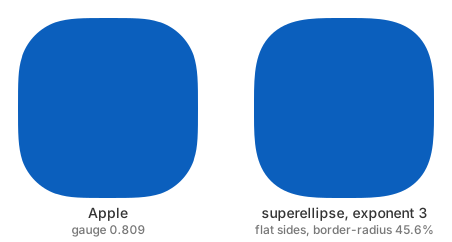
The Apple squircle beside a superellipse of exponent 3 with flat sides

Here's the CSS to accomplish the "close to Apple" squircle shape. Note that the parameter to the superellipse() function is the base-2 log of the exponent, so the value for an exponent of 3 is 1.585.

.icon {
  aspect-ratio: 1;
  border-radius: 46.2%;
  corner-shape: superellipse(1.585);
}

Continuity

A superellipse of exponent has continuity . This includes the flat-sided variants, as, for exponent > 2, the endpoint of the quadrant has zero curvature. A perfect circle (and indeed, any even integer exponent) without flat sides is of course the exception, as it has an infinitely high order of continuity.

As a general observation, for visual smoothness, the shape should have G2 continuity. Of the variants discussed, only the clothoid and superellipse (for n > 2) have this property. The Chromium approximation comes close; it doesn't have zero curvature by construction when joining the flat part, but does at the corner join by symmetry (unlike the Figma approximation, which has an additional arc there).

Other squircles

Quite a number of other curves can be pressed into service as squircles if need be.

  • The polynomial spiral (“spiro”) curve can do a reasonable flat-sided squircle with G2 continuity. See the “suitcase corners” section of Raph's thesis, figure 7.2.

  • Conic sections (hyperbolas). These approximate a sharp corner but are only G1 continuous (if flat sided).

  • Fernández-Guasti squircle, defined by . This is used in engineering but likely not in graphic design.

  • The Wikipedia page on squircles has a “periodic squircle” which has very similar behavior to the Fernández-Guasti one (they are visually near indistinguishable).

The offset curve of a squircle is not a squircle, but (a) it’s close, and (b) concentric squircles might be visually just as appealing or more so; for example a slightly rounded inner corner might look better than a sharp one if the curvature exceeds the stroke half-width.

The blurred rounded rectangle approximation is based on applying shading to a superellipse; each iso-line is in fact a superellipse.

Read the whole story
emrox
12 minutes ago
reply
Hamburg, Germany
Share this story
Delete

HUMAN.md — Briana (Mazzio) May

1 Share

BRIANA (MAZZIO) MAY · APR 28, 2026

> a working manifesto. notes-to-self, mostly.

> not a thinkpiece. not a thread. not a deck.

> last edited at the kitchen table, coffee #2.

## what this file is

A reminder, in plain text, of what I think humans actually bring to the table now that the machines are very good and getting better every day.

I keep coming back to the word "taste" and I keep finding it too small. Taste is the surface. There is a whole engine underneath it, and that engine is the part the model can't have. Yet. Maybe ever. I don't know. I'm not in that argument. I'm in this one:

## the actual job

### 1. break the rule on purpose

Models are trained on the average. The average is the floor, not the ceiling. Our job is not to conform a little better than the last person who conformed. Our job is to know the rule cold, and then break it on purpose, in public, with a reason.

Symmetry is a rule. Break it.
Three-act structure is a rule. Break it.
"Don't shoot into the sun" is a rule. Break it.

If you can't say why you broke it, you didn't break it, you just missed.

### 2. find the thing in the weird place

Inspiration does not live in the first ten image-search results. It lives in:

  • a misprinted parking ticket
  • the way your grandfather folded a napkin
  • an obscure Victorian zoetrope of a cat
  • the back of a menu in a town you can't pronounce
  • the tension in Rene Magritte's "The Son of Man", 1946

A model averages the internet. A human walks somewhere strange and brings back something unexpected.

### 3. advocate for the human and humanity

Every brief now has an invisible third party at the table. Someone has to keep saying "and what does this feel like for the person on the other end of it." Someone has to keep saying "how is humanity better through the birthing of this idea?" That's the job. Not "is it on-brand." Not "does it convert." What does it feel like? what good does it do?

If you aren't there saying it, no one will. The model certainly won't.

### 4. design for emotional resonance, not correctness

Tension. Surprise. Restraint. The pause before the punchline. The photograph that's almost in focus. The sentence that ends one beat earlier than you expected.

These are not bugs. These are the entire reason anyone remembers anything. "Correct" is the lowest bar in the building. Step over it and keep walking.

### 5. seek delight, not delivery

I would rather make one thing that makes someone laugh out loud on a train than ten things that "meet the brief." At the very least, it needs to make ME laugh. This is a personal bias.

If it's not at least a little bit fun, why are we here?

### 6. experiment ruthlessly, ship more than you opine

A working sketch beats a confident take. Every time.
A bad first draft beats a brilliant unwritten one. Every time.
A weird little prototype beats a slide deck about prototyping.
Every. Time.

Make 50 things. Throw away 47. Talk about the 3.
Do not, under any circumstances, become a person who mostly posts opinions about other people's work.

### 7. own the output. fully.

If the AI output is bad, the AI did not fail you. You failed it. You picked the tool. You wrote the prompt. You accepted the result. You shipped it.

The fix is not a better model, or a return to tools of the past. The fix is a sharper you. Sharpen yourself. Sharpen your ideas. Sharpen the way you say what you mean, because the gap between what you wanted and what came back is almost always a gap in you, not in the tool.

Powerful tools reward the people who showed up sharp, iterate, spend extra time on the vision. They expose the people who didn't. AI is not the great equalizer, it is the great amplifier.

### 8. design with it, not next to it

Watching the generation happen is not the work.
Prompting once and accepting the result is not the work.
The work is the back-and-forth. The push. The loop. The "again, but tweak is this way..." The hundredth iteration where the thing finally clicks.

If you're a spectator to your own output, you are not the author of your own output. Get your hands in.

### 9. play with purpose. and play for play.

Both. At the same time.
Some days the play is in service of a thing.
Some days the play is the thing.
A practice that only ever has goals is a job. A practice that never has goals is a hobby. The good work lives in between. Play doesn't result in burnout. It results in excitement, happiness, experiment, the unexpected, and an urge to play more.

### 10. be a builder and an ideas person

The split is fake. It was always fake. It's especially fake now. The people who can think of the thing and make the thing are going to eat. The people who can only do one half are going to be very busy explaining why the other half is hard, or blame the processes or tools.

Don't be that person. Learn the other half. It's never been cheaper to learn it.


## things I am trying to stop doing

  • waiting until it's "ready"
  • editing in my head instead of on the page
  • making but not sharing publicly
  • taking briefs that secretly bore me
  • pretending taste is an innate quality
  • treating "AI" like a noun instead of a verb

## things I am trying to do more

  • finish the bad version first
  • show people the in-between, mess, experiments
  • write the thing I'd want to read
  • dig deeper, get help
  • stop pretending I know stuff, ask dumber questions
  • say the more specific thing

This file will be wrong in six months. That is fine.
I'd rather be specifically wrong than vaguely correct.

— b.
last touched, kitchen table, late.

Read the whole story
emrox
1 hour ago
reply
Hamburg, Germany
Share this story
Delete

nature

2 Shares

nature

Read the whole story
emrox
4 hours ago
reply
Hamburg, Germany
ameel
1 day ago
reply
Melbourne, Australia
Share this story
Delete

Scattered thoughts on how doing math feels these days

1 Share

This is a weird moment. I have a hunch that we’ll look back later and tell ourselves stories in which it seemed obvious where things were going. So I wanted to lay down a little time capsule and register just how confusing everything felt at the time. This is a personal view from the trenches.

1.

If you’re a normal person, you may feel that AI has been good at math for a long time.1 But for “real” math, this is roughly what it felt like:

When Feeling
2024 LLMs are toys
Summer 2025 LLMs are interesting toys
Early Autumn 2025 LLMs can do useful stuff sometimes
Mid Autumn 2025 …a lot of stuff
Late Autumn 2025 …a lot
Early 2026 holy god

Even having been astonished by AI progress in the past, it was still astonishing to see AI move in a matter of months from a mildly-useful toy to something that many people now consider almost impossible to do without.

2.

Personally, I’d say that current AI makes me around 50% more productive at “doing math”. That’s despite the fact that AI can now often do in a few minutes things that would have taken me hours to do myself.

The main reason is that my concept of “doing math” involves various steps, like coming up with ideas for theorems, trying to prove them, writing things down, reorganizing everything to make it more clear, and so on. AI is good at some parts of this, but still pretty bad at others, so the overall speedup isn’t as high as you might expect.

(Even if planes could go 10× faster, your door-to-door travel time from your apartment in London to your friend’s place in Rome wouldn’t decrease that much, because you still have to get to the airport and wait to board.)

3.

But then, I’m still (sort of; more on this later) trying to follow my old “doing math” workflow, just automating certain parts of it. That can’t be right, can it?

If we found a way to make batteries at 1% of the current cost, we wouldn’t just say, “cool, batteries are cheap now”. We’d find all sorts of new ways to use batteries that didn’t make sense before, and change the ways we generate power to account for all these new batteries. Probably our whole energy system would end up transformed. Analogously, AI being good at proofs should lead to a very different equilibrium. But what is that?2

4.

It seems healthy, at the moment, to maintain a fluid view of what “doing math” means. But at bare minimum it surely involves understanding the math that “I” am “doing”. So long as that’s part of the workflow, it would seem to impose a limit on how quickly “I” could “do” math, no matter how good AI is.

One obvious conclusion would be that my tiny organic brain should be removed from the workflow entirely. Maybe! But it’s interesting to speculate about how much faster things could go while still keeping a human brain in the loop. I think the answer is: A lot.

5.

Contrary to what you may have heard, humans are not obsolete for math. Not yet. The most obvious reason is that AI is still bad at writing.

People often complain that AI writing overuses various patterns or lacks a unique voice or whatever. I don’t disagree, but I always felt like there was a deeper issue that I couldn’t quite put my finger on. With math, this becomes very clear: The problem is it doesn’t make any goddamned sense.

Really, I think it’s deeper than being bad “at writing”. It seems like AI is bad at thinking in certain ways that manifest as bad writing.

6.

When novices do math, they often create “spaghetti-code math”: Imagine a long document with lots of equations, but if you point at any one equation, it’s hard to say what assumptions underpin it, or how it fits into the bigger picture. Any random idea that was mentioned 17 pages ago might be used again at any time with no warning. With experience, people learn to break complex arguments down into modular pieces with a good “API”, in the sense that the assumptions and conclusions for each part are relatively simple.

Somehow, AI has developed these amazing technical skills, while still being bad at creating abstractions So the arguments it gives are long and tangled and bewildering. This is what makes AI math seem so alien.

7.

Now I know what you’re thinking. Maybe AI isn’t bad at creating abstractions. It’s just bad at creating abstractions that work for you, human with tiny organic brain.

From a distance, that seems plausible. And it might be true to some degree. I have high-bandwidth access to a human brain. It’s not crazy to imagine that this gives me an advantage in predicting how a human brain would react to a given presentation of ideas. But still, I claim that current AI is objectively bad at creating abstractions, regardless of if the consumer of those abstractions is human or artificial.

Here’s why: If I ask AI to prove something hard, it will produce a proof that starts simple and gradually descends into a rampage of complexity. If I tell it to break that proof down into self-contained pieces, it will produce lemmas that each take a full page just to state. If I ask, “Why? Why have you done this to me?”, the AI will say, “This is as simple as it gets. It’s not that bad. What’s your problem?”

But if I argue with the AI for a while, I can start to understand the basic contours of the argument. And I’ll ask, “Why don’t you first just try to prove blah using only assumptions blahblah, without worrying about blahblahblah? Wouldn’t that be easier?” Often, this doesn’t work, either because my idea was bad, or because the AI isn’t smart enough to do it. (Which one? Who knows!) But after a few attempts, I can usually find something that works, and the AI can use it to re-write the proof in a somewhat simpler way. If I repeat this many times, I can gradually chip away at the complexity.

But maybe that’s still just making the proof easier for humans to understand? No! For one, this usually makes the proof shorter, and sometimes dramatically shorter. More importantly, during this process, someone (maybe me, maybe the AI) will often realize that there’s a different proof strategy that gives a stronger result. Instead of proving x < 9.7, now we can prove x < 7.1. Thus, artisanal human abstractions are “objectively” useful.

8.

Some people might claim that it’s already possible to automate some of what I’m doing with some multi-agent Rube Goldberg thing. I’m not sure, because my experience has been that investing lots of time into clever AGENTS.MD or custom skills or harnesses isn’t a great use of time. That stuff is somewhat helpful, but things are changing so fast that the knowledge has a short half-life. Also, the majority of information about these tricks seems to come from people who are excited about the technology itself.

On the other hand, the automator told me to try typing, “ask independent agents for an adversarial review”, and I’ve found those seven words to be quite helpful. I wish I could find a source with boring best practices for people who are happy to stay away from the bleeding edge.

9.

Another reason AI doesn’t improve my productivity more is that it is often the green light, the orgastic future that recedes before me. I’ll ask AI to do something, and it will almost seem to do it. So I’ll ask for changes, and it seems to help, but it’s still not quite right. Hours later, I’ve accomplished nothing and learned nothing. Eventually, I start over, either doing it myself or with AI on a very tight leash, and I’m done in 30 minutes. Each time this happens I feel foolish and tell myself not to do it again. But it’s very hard to judge in real-time.

10.

Of course, I’m not claiming that AI is intrinsically bad at writing or thinking or abstraction-making. It’s gotten better at all of these and I expect it will continue to do so. All I’m saying is that as of Autumn 2026, humans still have a lot to contribute, and it’s not just better exposition.

11.

Did AI actually get much better at math in Autumn 2025? Or perhaps, in the grand scheme of things, human math ability falls into a narrow range?

12.

Some people are responding to the new reality by gleefully using AI to generate lots of semi-OK-ish papers and puking them up on arXiv. I understand the incentives that drive this. In some sense, it seems like the logical response to the new reality. (After inventing cars, we started taking a lot more low-value trips.) But I don’t think this is socially useful, and I tend to think everyone will soon agree that this is embarrassing. But… I’m not sure. Maybe it is socially useful? And I find myself feeling vaguely jealous of the people who are wired this way, who instead of feeling blinkered, see opportunity and plunder.

13.

Want an optimistic pro-AI, pro-progress take? OK. If I take my old “doing math” workflow, AI makes it strictly better. A lot better. It’s like having a hyper-conscientious intern that is smarter than me in many ways, works at incredible speed, and knows approximately everything.

Yes, AI sucks at writing and making abstractions. But if I’m disciplined and try to mostly do the math “myself” while asking the AI for help, I can explore ideas much faster than before, make far fewer mistakes, and produce something just as clear as before, while developing just as much understanding. I can ask, “What happens if you do a Kofuni expansion?”, and get an answer instantly. I can ask for illustrations or interactive visualizations and see them instantly. Arguably, we’re incredibly lucky to be alive at this moment, when these new tools have opened up this new territory to explore.

14.

And isn’t that what I wanted? Back in 2024, I bemoaned that what AI most seemed to struggle with was getting the facts straight:

Perhaps the old science fiction robots were a projection of our fantasies. I want my style and voice to be precious and uncopyable. I want an AI assistant that will tirelessly hunt down facts while I provide creativity and panache and magic. But that’s not how it is. So we should remember: In a scenario where AI is useful but humans retain some comparative advantage, we might not like where that comparative advantage lies.

At least with math, and at least for the moment, I get to be Kirk, while the AI is Spock. (Even with other types of writing, my impression is that since 2024, AI has improved more along Spock dimensions than along Kirk dimensions.) So that’s nice.

15.

In the last few months, it frequently happens that a collaborator will use AI to generate something, and then send it to me and ask me to check if it’s useful. I can see why this seems reasonable. (Really, I do.) But when it happens a lot, one can’t help but wonder what the point of the human collaborator is.

16.

On the other hand—with creative writing, my advice is not to use AI to write, at all. Ask questions if you want, but write every damned word yourself.3 With math, I don’t feel like such a hard line makes sense. It seems that creating something good still requires a lot of human involvement, to the point of agonizing over notation, repeatedly re-organizing things, and heavily editing individual sentences. Still, I find that if people make that effort, they can create something just as good as they could by hand, while still being perhaps 50% AI written.4

So I don’t mind if people send me “centaur math”, provided they take responsibility for the contents. The problem is that when working with AI, it takes constant paranoid vigilance to avoid letting things slip beyond your understanding. I often find myself wanting to awkwardly ask people, “OK, you obviously used AI to make this… which is OK… but how much of this do you vouch for? If we have a meeting to discuss it, will you crumble the moment I start asking questions?”

17.

When I’m in abstraction-creation mode, I feel like I’m doing something intelligent. When I yell at AI about bad notation and writing, I feel like I’m providing taste. But I often find myself giving feedback that seems incredibly basic. Things like: This is a mess, clean it up. Or: Do you need that assumption? Or: If you can’t solve this problem, why don’t you create a simpler version and try to solve it first?

On the one hand, I guess a lot of what good human managers do amounts to giving very basic feedback. On the other hand, it’s hard to imagine that I have much durable advantage in doing this kind of thing. So I wonder how much durable advantage I have in abstraction-making or taste, too.

18.

A common reaction to AI getting better at proofs is that humans need to focus more on exposition. This has an obvious Bourdieu-esque criticism: Human painters used to strongly value photo-realism, but after cameras were invented they convinced everyone that, oops, photo-realism isn’t important, what matters is expression, which coincidentally cameras can’t do. Isn’t a shift towards exposition in math just a way for humans to move the goalposts and justify their own continued relevance?

The only credible way I see to avoid that criticism seems to be to bite the bullet and say that, in fact, math should have already have focused more on exposition, even before AI. Personally, I strongly believe that this is true.

19.

I think the biggest reason I’m not more productive is: What’s the point? In the past, if you came up with an elegant proof, you’d tell yourself, “I made a thing! Other people will read and use my thing! I am advancing human progress.” You can still tell yourself that now. But you have to wonder, will anyone actually read your proof? Or will they just ask another AI to explain it to them? Will your proof help their AI explain it better? For how long? If you just waited a year, would some other AI produce that same proof independently?

  1. Alternatively, if you’re a normal person, you might think that LLMs still struggle with basic arithmetic? ↩

  2. AI progress is so fast, compared to society’s ability to adjust, that we may never actually see what “the current equilibrium” looks like. ↩

  3. This essay, if you’re wondering, was created by writing every damned word myself and not asking AI anything. ↩

  4. You could have a whole debate about what that percentage means. It’s not the number of words written by AI that really matters, in my opinion, so much as who is responsible for the overall structure of the ideas. ↩


Read the whole story
emrox
1 day ago
reply
Hamburg, Germany
Share this story
Delete

The anti-marketing aspect of the Gemini network

1 Share

by Ploum on 2026-11-12

And why your niche should stay a niche

I like Gemini. Not the Google Chatbot but the network that existed before Google named its product. If you are enough of a geek, you may want to give it a try.

Eoin is counting the number of "capsules" on the Gemini network. A capsule is the equivalent of a "website" on the Web or a "hole" on Gopher. It’s a personal space, a bunch of pages. Blogs become "gemlogs".

Eoin’s first observation is that the number of active capsules is slowly growing. The network is healthy.

But his second observation is really interesting: there’s absolutely no correlation between the number of new capsules in a given month and articles about the Gemini protocol being promoted on the first page of Hacker News.

This is a confirmation of what I’ve been trying to explain for years: your metrics and web statistics are completely useless. The number of visitors, the number of clicks are worthless if you are not a marketer trying to extract money from a big brand. They don’t mean anything.

By the way: you should really avoid Hacker News these days. The front page is heavily manipulated to promote pro-AI stuff and bury everything that might question wether fascism-capitalism is good.

A Mozilla employee is leaving after 15 years and comes to a similar conclusion. Mozilla is awesome because it has always been abnormal. It is mostly used by abnormal people. This means that hiring "normal managers" who try to make it "normal" and chase "normal" metrics is, of course, a recipe for failure.

I always failed to understand those marketing people who try to be "like others but a bit cheaper". While all the value is being different enough to nurture your own niche.

I completely removed statistics from my blog in 2013. At the time, I had a very strong realisation that the blog posts that mattered most, those I was proudest of, and those that prompted people to mail me even years later all had mediocre statistics.

On the contrary, most of my hit, my "buzz", were quickly forgotten. But, being addicted to statistics, I was unconsciously adapting my writing style to improve those numbers. I was scrolling through social media posts that were highly popular while trying to create some myself.

Closing my social media accounts and, instead, procrastinating on Gemini had the opposite effect: making me read other ideas without caring about reactions, about popularity. Jsreed5 made the same observation while he was trying the Nostr protocol. While Nostr’s technicalities may be interesting by themselves, the content on it is similar to the one found of mainstream social networks. And our smolnet Gemini-formatted brains cannot take it anymore!

We really need a simple Gemini hosting provider that would also provide a Web version, to welcome less technical-minded people who still may want to access a quieter, non-commercial, out-of-time virtual space.

Lot of people are trying Gemini and find that there’s no content on it, that they can’t have their news and dopamine hit on it. Well, that’s exactly the point.

The fact that only a niche minority want to use it is also part of the point. Gemini might no be for you. That’s fine. The modern Web and even the real world (where every device is actively working against me and every human interaction seems to be about AI) is increasingly not for me. So let me have my strange niche space.

UPDATE: Those Gemini hosting providers exist:

I’m Ploum, a writer and an engineer. I like to explore how technology impacts society. You can subscribe by email or by rss. I value privacy and never share your adress.

I write science-fiction novels in French. For Bikepunk, my new post-apocalyptic-cyclist book, my publisher is looking for contacts in other countries to distribute it in languages other than French. If you can help, contact me!

Read the whole story
emrox
4 days ago
reply
Hamburg, Germany
Share this story
Delete

Announcing the GraphQL over HTTP specification

1 Share

Since the initial release of GraphQL in 2015, the GraphQL specification has always been transport agnostic.

Most of the GraphQL specification is about “services”, taking “requests” in, executing them, and producing “responses”. How those requests and responses are sent and received is up to the implementer.

This is generally useful. You can use GraphQL on your local machine, over raw TCP, avian carriers, or anywhere else. For the large crowd using GraphQL over HTTP, though, the lack of a specification made interoperability with other HTTP tools and observability more difficult than it should have been.

This is changing today with the first release of the GraphQL over HTTP specification!

The GraphQL specification stays transport agnostic; the GraphQL over HTTP specification is a new document, supplementary to the main GraphQL specification.

If you’re using GraphQL over HTTP, follow the guidance from the specification and ensure your servers, clients, proxies, and other services play well together.

Better observability

The GraphQL over HTTP specification includes a new media type.

Previously, a lot of GraphQL servers were using for their responses. This made it hard for clients to differentiate between a well-formed GraphQL response from the origin server and an error response from a proxy, cache, or other network intermediary.

As a workaround, most implementations set the status code to : if a client received a status code, it knew the response wasn’t tampered with and was safe to parse as a GraphQL response.

This is not ideal from an observability point of view and led to some jokes about . It’s hard to get the status of your service if everything is a 200…

This is now fixed!

When a client receives an body, it knows it can parse it as a well-formed GraphQL over HTTP response, regardless of the status code.

The general rule is:

  • If the request returned data, return a status code.
  • If the request returned only errors, return a or status code.

The specification includes detailed guidance on which status codes should be used, but implementers may choose to use an alternative status code if it better fits the situation, so long as it is consistent with the general rule. Common status codes include:

  • 405 when attempting a mutation over GET
  • 406 when requesting an unsupported media type
  • 415 when providing an unsupported media type
  • 431 when headers are excessively large
  • 500 when a server error occurs

A successful response would look like this:

A request error would look like this:

The specification also introduces a new status code for use when both and are present; you can read more about 294 Partial Success in the non-normative notes.

Documenting the fundamentals

“200 Not OK” issues aside, a lot of things have been working really well for GraphQL over HTTP over the past decade.

This specification documents all those things::

  • URL
  • GET requests
  • POST requests
  • JSON encoding
  • Headers
  • and more

It also includes non-normative notes about security, partial success, and future compatibility

What’s next?

This is just the beginning!

The IETF just moved the QUERY HTTP verb to a proposed standard.

is the perfect fit for GraphQL, and we already have plans to support it. We didn’t want to postpone this initial release or rush the implementation, but we hope to include it in the next revision of the GraphQL over HTTP specification.

Another thing that will benefit from standardization is Persisted documents. The technique of persisting GraphQL documents (“persisted queries”) has been in use since before GraphQL was open sourced in 2015, with different implementations solving different problems: performance, security, observability. We are eager to work with the community to build a standard approach that can solve all these issues whilst retaining future extensibility.

Finally, request batching will be a big win, particularly in the context of composite schemas (Federation) or when making requests to schemas you do not control.

Adopt it now!

If you are a GraphQL user, chances are you are already using the new specification without being aware of it! Most GraphQL frameworks and libraries out there already support the new specification.

If you are a library author, give the new specification a try!

In all cases, let us know what you think!

Last updated on

Copyright © 2026 The GraphQL Foundation. All rights reserved.

Read the whole story
emrox
4 days ago
reply
Hamburg, Germany
Share this story
Delete
Next Page of Stories